
Find All Factors of Any Number Easily Online
Find all factors of any number with our free Factor Calculator. Simply enter a number and get accurate results with easy step-by-step solutions. This online tool helps students and teachers understand factors and solve math problems quickly. No signup or download required.
Factor Pairs
Step-by-Step Solution
What Is a Factors Calculator?
A Factors Calculator is a free online tool that finds all the factors of a given number. Factors are whole numbers that divide another number exactly, without leaving a remainder. For example, the factors of 12 are 1, 2, 3, 4, 6, and 12. Each number divides 12 evenly. Finding factors by hand is simple for small numbers. But larger numbers can take more time. This calculator makes the process easier and shows the answer with clear steps.
Students can use it for homework, while teachers can use it to explain basic number problems.
How to Calculate Factors of a Number
You can find factors by checking which whole numbers divide a number without a remainder.
Let's find the factors of 24.
Step 1: Start with the number 24.
Step 2: Divide 24 by positive whole numbers.
Step 3: Keep the numbers that divide 24 exactly.
Step 4: Write all the factors in ascending order.
The factors of 24 are:
1, 2, 3, 4, 6, 8, 12, 24
These numbers are called factors because each divides 24 without a remainder.
You can follow the same method for other positive whole numbers.
How to Use the Online Factors Calculator
Our online tool makes finding factors quick and simple. You do not need to remember any difficult formulas.
Follow these steps:
- Enter a positive whole number in the input box.
- Click the Calculate Factors button.
- Check the complete list of factors.
- View the factor pairs shown below.
- Read the step-by-step solution.
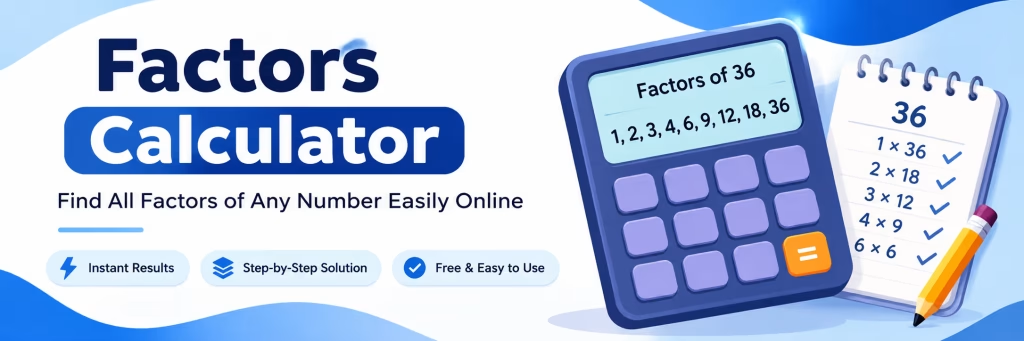
For example, enter 36.
The calculator displays:
Factors: 1, 2, 3, 4, 6, 9, 12, 18, 36
Total factors: 9
You can enter another number whenever you want. The tool works directly in your browser without registration.
What Are Factor Pairs?
Factor pairs are two whole numbers that multiply to give the original number.
For example, the factor pairs of 36 are:
- 1 × 36 = 36
- 2 × 18 = 36
- 3 × 12 = 36
- 4 × 9 = 36
- 6 × 6 = 36
Each pair helps you identify the factors of 36.
Factor pairs are useful when learning multiplication, division, and number properties.
Prime Factors and Common Factors
Prime factors are prime numbers that multiply together to make a given number.
For example:
24 = 2 × 2 × 2 × 3
Here, 2 and 3 are the prime factors of 24.
A Prime Factorization Calculator helps break a number into its prime factors. It is useful when working with larger numbers.
Common factors are numbers that divide two or more numbers exactly.
For example:
Factors of 12: 1, 2, 3, 4, 6, 12
Factors of 18: 1, 2, 3, 6, 9, 18
Common factors: 1, 2, 3, 6
The greatest common factor is 6.
Difference Between Factors and Multiples
Factors and multiples are related, but they are not the same.
A factor divides a number exactly. A multiple comes from multiplying a number by a whole number.
For example:
Factors of 6: 1, 2, 3, 6
Positive multiples of 6: 6, 12, 18, 24, 30, 36...
A number has a limited number of positive factors, but it has infinitely many positive multiples.
A Multiples Calculator helps you generate multiples without writing the multiplication table manually.
Understanding this difference makes many basic math problems easier.
Related Online Math Calculators
Different math problems need different tools. Here are some useful calculators that work with factors, multiples, and fractions.
LCM Calculator
An LCM Calculator finds the Least Common Multiple of two or more numbers. For example, the LCM of 4 and 6 is 12.
LCD Calculator
An LCD Calculator finds the Least Common Denominator of fractions. It helps when adding or subtracting fractions with different denominators.
GCF Calculator
A GCF Calculator finds the Greatest Common Factor of given numbers. For example, the GCF of 16 and 24 is 8.
HCF Calculator
An HCF Calculator finds the Highest Common Factor. HCF and GCF mean the same thing, so both give identical results.
GCD Calculator
A GCD Calculator finds the Greatest Common Divisor. GCD is another name for GCF and HCF.
Fraction Calculator
A Fraction Calculator helps you add, subtract, multiply, or divide fractions. It makes fraction calculations easier to check.
Simplifying Fractions Calculator
A Simplifying Fractions Calculator reduces fractions to their simplest form. For example, it simplifies 12/18 to 2/3.
Equivalent Fractions Calculator
An Equivalent Fractions Calculator finds fractions that represent the same value. For example, 1/2, 2/4, and 3/6 are equivalent.
Prime Number Calculator
A Prime Number Calculator helps determine whether a number is prime. A prime number has exactly two positive factors: 1 and itself.
Divisibility Calculator
A Divisibility Calculator checks whether one number divides another without leaving a remainder.
Fraction to Decimal Calculator
A Fraction to Decimal Calculator converts fractions into decimal values. For example, 3/4 becomes 0.75.
These tools cover different number problems. You can choose the one that matches your calculation.
Why Are Factors Important in Math?
Factors appear in many everyday math problems.
You use them when simplifying fractions, finding common divisors, and dividing objects into equal groups.
For example, imagine you have 24 pencils. You want to arrange them into equal groups without leaving any pencils.
You could make 2 groups of 12, 3 groups of 8, or 4 groups of 6.
Knowing the factors of 24 helps you find these arrangements.
Factors also help students understand multiplication tables and number relationships.
Common Mistakes When Finding Factors
One common mistake is confusing factors with multiples. Remember that factors divide a number, while multiples come from multiplication.
Another mistake is forgetting 1 and the number itself. Every positive whole number has both as factors, although they are the same number when the input is 1.
Some students also miss factor pairs when checking larger numbers.
Writing factor pairs first can help you avoid missing any values.